|
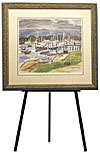
Suggested Framing Procedure..
The basic goal in framing fine art is to frame it in such a way as to have it suspended in the midst of the frame - untouched by anything inside or out. Naturally, there are practical limits to achieving this goal -- that is unless, your art can somehow magically float :)
Fine art
must be carefully mounted using only professional, acid-free and non-permanent
materials and to the minimum extent possible. Normally, fine art prints, such as ours, are produced using 100% acid-free paper
and canvas. Acid-free papers, as the name suggests, are made of material that contain no acids, such as cotton. This is important, because products that contain acids (such as those made of wood pulp) will
react with airborne moisture (humidity/water) and once activated,
these
acids
begin
to breakdown the paper or canvas, producing yellowing, cracking and finally
disintegration of the material -- and destruction of the art. Even if the paper or canvas that the art is made of is acid-free, if it is attached or remains in contact (for
an extended period) with materials that do contain acids, the acid-containing
material will react with moisture and stain the acid-free material, causing damage to the artwork.
Here are some important points to keep in mind when framing your fine art. Following these simple guidelines will ensure that your art
lasts for generations to come!
~ IMPORTANT FRAMING
INSTRUCTIONS ~
Summary
There are basically two key goals when framing fine art. Firstly, we
want to preserve and protect the art against any possible damage and
secondly,
we want to enhance the beauty of the art by selecting a frame and matting
that fits the art and fits our decorating taste. This section deals
only
with the first goal (to preserve and protect the art). This is accomplished
by doing as much as possible to isolate the artwork from the outside
environment and framing material. This isolation is achieved by basically suspending
the artwork within a frame, such that the mounting components that
attach
to the art (matting and adhesives) do not adversely affect the art material
(paper or canvas) and that the finished product allows for great viewing,
but most importantly creates a barrier between the art and the outside
world. Here are the steps to achieve this goal..
- Matting and Mounting - Use only acid-free matting
(usually called archival matting...it costs just a bit more,
but it is worth it). Likewise, use only non-permanent, acid-free
adhesives when mounting the art to the matting. Use as little adhesive as possible. Framed art can include
color coordinated double or single matting, and we suggest a minimum
of a 1 to 4 inch boarder, between the inner part of the frame and
the
artwork. The back of the mounted artwork is supported and protected
with acid-free foam board and some framers will also back the artwork
with
a second sheet of acid-free matt board, followed by the foam board.
The acid-free foam board backing is carefully cut to tightly mend
with
the inner part of the frame and the back of the frame is further protected with a sheet of craft paper that attaches to the frame edge.
Whenever possible never cut or fold the edges of the artwork or allow a framer
to do so. The paper size and margins have been selected by
the artist and are an integral part of the work. Have the art framed
as is, even
if the full margins are not displayed.
- At this point in our framing procedure we have the artwork mounted
to the acid-free matting and backed with a sheet of acid-free foam
board -- or -- a second sheet of acid-free matt board, followed by
foam board.
- Facing Material - U.V. Protecting Glass facing is
used whenever possible.
Plexiglas or Lexan may also be used, but requires special care when
cleaning and handling...as described in the "Caring
for..." section. In either case, the facing material
must not touch the artwork! One of the the purposes of mounting
the art to matt paper is to form an air-gap between the artwork
and the facing.
- At this point in our framing procedure we have the artwork mounted
to the acid-free matting and sandwiched between the acid-free foam
board backing and the glass or Plexiglas/Lexan facing.
- Finishing - Once the mounted artwork and facing is
installed to the frame, framers tape (or a clear transparent tape)
is used to seal the rear of the frame edge to the foam board. Specifically,
seal the gap that exists between the rear inner edge of the frame and
the acid-free foam board. For final finishing, a 50 lb. weight (usually
brown craft type) construction paper is used to complete the
backing of the frame. This ensures that dust stays outside of the framed
piece. The construction paper is adhered to the rear of the frame with
double-sided tape. Rubber button spacers can be added to the rear lower
corners of the frame to protect your walls from marks and also to stop
the art from moving easily. These smart additions also allow air to
freely circulate between the wall and the artwork, reducing the possibility
of moisture buildup and mold.
Finally, two heavy duty metal loops are screw-mounted to the frame back
and thick-gauge picture hanging wire is run loosely between them, with
the ends wrapped and taped (to protect your walls). One or two
heavy picture hanging hooks are used to hang your framed art.
- Hanging - Never place art of any kind in direct sun light or
in a room where strong direct sun light exists. Sun light contains ultraviolet
rays that can damage and will fade colored pigments. Further information
is included in our "Caring for..."
section.
If you have questions regarding the proper framing
of your art,
please do not hesitate to call us at (631) 223-2700
Have more questions?
You can reach us at E-mail address service@tiscorp.com
Copyright © 1995-2013 TIS Corp. All rights reserved.
|